
strategic themes
Our strategic areas of research

Healthy aging
Lead: Professor Olga Zayts-Spence (HKU CHM)
Contributors & Collaborations: Professor Lihe Huang (Tongji University); Dr. Mohammad Momenian (HKU); Dr. Carmen Wong (CUHK); Dr. Carol Tsang (HKU); Dr. Wendy Wong (HKU); Dr. Mariana Lazzaro-Salazar (Universidad Católica del Maule)
At the Centre for Humanities and Medicine, our research on healthy aging investigates how communication practices and technological interventions shape the experience of the life course in contemporary Asia and beyond. We move beyond purely clinical or biological definitions of health to examine the social, linguistic, and cultural dimensions of aging well. Our projects explore the multicultural and intergenerational dynamics in managing health with the progression of age. We examine the stigma and taboos surrounding aging, familial and public narratives about ‘contended aging’, as well as the technological challenges and opportunities in healthcare for older adults (such as the popularisation of telemedicine and AI-assisted care). By focusing on both family caregiving networks and institutional healthcare settings, our team takes an ecological approach to the healthcare communication systems surrounding older adults. Guided by principles of evidence-based research, we aim to develop humanistic frameworks that ensure technological advancements in geriatric care enhance, rather than diminish, autonomy and dignity. Our latest projects centre on women’s health across the lifespan, and the management of death and dying in institutional settings.
.png)
mental health
Lead: Professor Olga Zayts-Spence (HKU CHM)
Contributors & Collaborators: Professor Clare Dannenberg (University of Canterbury); Dr. David Matthew Edmonds (HKU CHM); Professor Zoë Fortune (Heriot-Watt University); Dr. Pauline Luk (HKU Medicine); Dr. Jasper Zhao Zhen Wu (HKU CHM)
Our work in mental health addresses the critical communicative and technological transformations occurring in psychiatric care and public well-being, with a specific focus on youth mental health. The Centre recognises that mental health conditions are not only biomedical issues but are also profoundly shaped by societal discourses: stigma, cultural idioms of distress, and the language of diagnosis and therapy. We investigate the reshaping of mental health discourse and therapeutic relationships in relation to technological transformations – such as online therapy platforms, mental health apps, and generative AI. We are particularly focused on the communicative dimensions of mental health support. Our projects study mental health discourses in clinical, university and workplace, and digital community contexts. Through cross-cultural studies, we explore how mental health literacy and help-seeking behaviours are negotiated across different communities in Hong Kong and the broader Asian context. Our team works in close relationship with policymakers, corporate leaders, and prominent NGOs in promoting mental health in higher education and the workplace (see events). Currently, we are leading studies on the mental health of cross-border graduates in the Guangdong-Hong Kong-Macao Greater Bay Area, and the public discourse over generative AI in the practice of mental health support.

gender and sexuality
Lead: Professor Brian King (HKU CHM)
Contributors & Collaborators: Dr. Alison So (HKU)
The Centre approaches gender and sexuality as critical axes through which medical knowledge, power, and care are negotiated. Our research interrogates how healthcare communication reproduces or challenges gendered norms, and how technologies intersect with lived experiences of embodiment and identity. We examine the linguistic practices in clinical encounters related to sexual health, reproductive rights, LGBTQ+ healthcare, intersex variations, and body aesthetics, paying close attention to how the medical field and public discussions navigate sensitive topics. Our projects investigate the role of digital media and health technologies in shaping the language of risk, danger, and anxiety around gendered healthcare norms. Through critiques of biopolitics and bioethics within and beyond clinical practices, we strive to contribute to building a more inclusive, respectful, and patient-centred healthcare environment for marginalised groups in Hong Kong and the broader global community.
Genetics & Genomics
Lead: Professor Olga Zayts-Spence (HKU CHM)
Contributors & Collaborators: Dr. Luo Zhengpeng (Peking University)
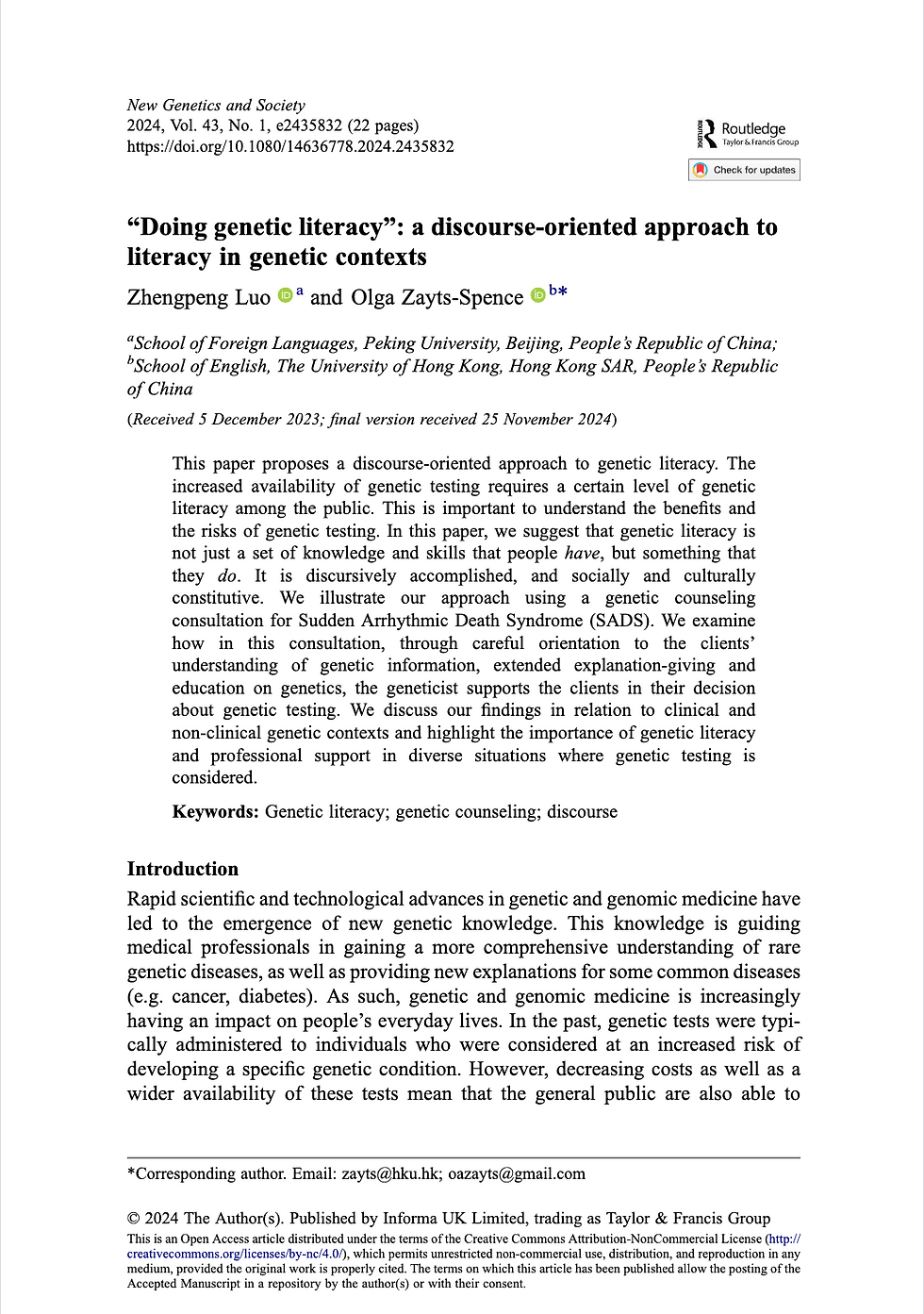
As genomic technologies rapidly transform the landscape of modern medicine, the Centre for Humanities and Medicine provides humanistic inquiry into their social, ethical, and policy implications. Our research focuses on the communication of complex genomic information into clinical practice and public understanding. We investigate how genetic risk is communicated in counselling sessions, how patients and families make meaning of probabilistic genomic data, and how direct-to-consumer genetic testing shapes individual and collective identities. Drawing on our expertise in discourse analysis and ethnography, we study the interactions in genetic clinics to improve the clarity and empathy of information exchange. Furthermore, we engage with the ethical dimensions of emerging technologies like gene editing and AI-driven genomic analysis, ensuring that the rapid advancement of precision medicine is accompanied by rigorous reflection on autonomy, privacy, and equity.
.png)
Culture in healthcare
Lead: Professor Olga Zayts-Spence (HKU CHM)
Contributors & Collaborators: Dr. Yu Yang (Shenpingtang, Shenzhen)
At the Centre, we understand culture not as a static backdrop but as active, dynamic processes shaping every dimension of health and medicine. Our team approaches culture at the intersection of clinical practices, corporate and NGO initiatives, governmental planning, and popular discourses. We examine how cultural assumptions are embedded within healthcare systems, medical technologies, and communication protocols. Our projects explore developments in cross-cultural clinical communication, the integration of traditional and complementary medicine with biomedical practices, and the cultural brokerage roles played by interpreters and community health workers. In a multilingual and multicultural hub like Hong Kong, our work is essential for identifying and dismantling barriers to equitable care. By bringing a nuanced understanding of culture to the forefront of medical humanities, we aim to foster healthcare environments that are genuinely responsive to the diverse populations they serve. Our latest project focuses on the cross-border synergy in the Guangdong-Hong Kong-Macao Greater Bay Area in integrating the practices of Western medicine and traditional Chinese medicine.